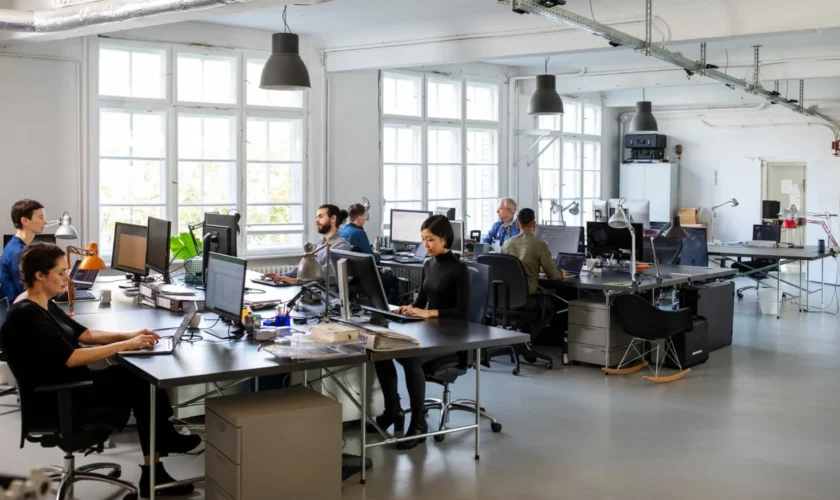
Office desk partitions stand as silent arbiters of our professional lives, segmenting space, controlling visual access, and establishing the unspoken boundaries that govern our workday interactions. I first noticed their outsized influence while interviewing office workers for a research project in Singapore’s central business district—how these seemingly innocuous dividers created invisible hierarchies, altered communication patterns, and shaped organizational cultures in ways few had consciously considered. The junior analyst with the lower partition reported feeling perpetually monitored; the senior manager whose workspace was shielded by higher barriers enjoyed the psychological privilege of privacy; the new hire positioned near the walkway with minimal screening described a constant state of disruption. Physical boundaries, I realized, were never just about space.
The Evolution of Workplace Division
The history of partitioning office space reveals much about our changing relationship with work itself. The open bullpens of early 20th century clerical pools—where workers toiled under constant supervision without barriers—evolved into the cubicle farms of the 1980s and 1990s, which promised privacy but delivered a peculiar form of isolation. The pendulum then swung toward completely open workspaces, ostensibly to foster collaboration but often resulting in distraction and dissatisfaction. Each iteration revealed the tensions between supervision and autonomy, collaboration and focus, community and individuality.
“Singapore’s office design evolution mirrors these global shifts but with distinctive local adaptations,” explains Dr. Raymond Tan, workplace psychologist at Singapore Management University. “Our space constraints and cultural emphasis on both hierarchy and collective harmony have produced unique approaches to partitioning. The typical Singaporean workspace uses lower partitions than North American counterparts but with more deliberate zoning between departments.”
The Hidden Psychology of Partitioned Space
The psychological impact of workspace partitioning runs deeper than most organisations acknowledge. My conversations with office workers across Singapore revealed complex emotional responses to their divided environments:
- Privacy and status anxiety when partition heights correlate with seniority
- Territorial behaviours emerging around even minimal boundary markers
- Altered communication patterns when visual access is restricted
- Psychological ownership increasing with defined personal space
- Stress responses related to perceived surveillance or exposure
“In our Singapore workplace studies, we’ve documented measurable physiological responses to different partition configurations,” notes Professor Lim Wei Ling of the National University of Singapore’s Workplace Design Institute. “Cortisol levels—our body’s primary stress hormone—fluctuate significantly based on workstation exposure and boundary definition. These aren’t merely preferences; they’re biological responses with real health implications.”
The Equity Dimension of Office Division
As with many workplace practices, the distribution and quality of office partitioning often reflects and reinforces existing power structures. During my site visits to Singapore offices, I observed consistent patterns:
- Executive workspaces featuring high-quality acoustic partitions and premium materials
- Middle management allocated standardised, moderate-height dividers
- Entry-level positions frequently positioned in the most exposed areas with minimal screening
- Contract workers and interns often denied any meaningful workspace boundaries
This spatial hierarchy creates a visibility divide where the most powerful enjoy the privilege of privacy while the most vulnerable remain perpetually exposed—a physical manifestation of organisational power dynamics that silently communicates who matters and who doesn’t.
“What we’re beginning to understand through our research in Singapore’s corporate environments is that equitable partition allocation significantly impacts employee wellbeing and productivity,” explains Dr. Sarah Teo, workplace equity researcher. “When organisations democratise access to appropriate visual and acoustic screening regardless of rank, they typically see improvements in satisfaction metrics across all employment tiers.”
The Singapore Approach to Workspace Division
Singapore’s approach to office partitioning reflects its unique cultural and practical considerations:
- Space optimisation solutions due to premium real estate costs
- Thoughtful balancing of hierarchical respect with collaborative necessity
- Incorporation of biophilic elements to soften division points
- Modular systems allowing reconfiguration as team needs evolve
- Integration of technology into partition structures
“What distinguishes Singapore’s most successful office environments is their thoughtful approach to partitioning as a strategic tool rather than an afterthought,” observes workplace designer Mei Lin Wong. “The best implementations here recognise that barriers serve psychological and social functions beyond mere space division.”
Beyond the Physical: Partitions as Metaphor
The most important insight from my exploration of Singapore’s office environments is that physical partitions often mirror and reinforce the intangible divides within organisations. The senior leadership team separated from general staff by substantial barriers inevitably develops communication gaps. Departments isolated from each other by partition systems struggle to collaborate effectively. The visible and invisible boundaries align with remarkable consistency.
Progressive organisations have begun recognising workspace division as both literal and metaphorical—addressing both dimensions in their design thinking. Some are experimenting with mixed approaches that provide necessary focus space while strategically removing barriers at key interaction points. Others rotate seating arrangements quarterly to prevent departmental silos from forming.
As workplace dynamics continue evolving, particularly in the wake of pandemic-related disruptions, thoughtful approaches to space division have never been more critical. The organisations that thrive will be those that understand the profound impact of their environmental choices—recognising that seemingly mundane decisions about office desk partitions ultimately shape the culture, communication patterns, and human experiences that define their professional communities.